
Roof pitches below 2° & box gutters: Limitations of pliable building membranes
Pliable building membranes vs waterproofing membranes
We often get questions about using our Weather Resistive Barriers (WRBs) on roof pitches below 2°. Where a pliable building membrane is installed as a water control layer, AS 4200.2 Pliable building membranes and underlays states installation requires a minimum slope of 2° to allow drainage. In New Zealand, E2/AS1 (External Moisture) sets the minimum at 3°. Below these pitches, runoff slows and water stays in contact with the membrane for longer. This increases the risk of standing water, capillary migration through laps, and leaks at poorly sealed junctions and penetrations. At that point, the membrane is effectively required to act as a waterproofing layer, a function WRBs are neither designed nor warranted to perform.
Below 2°/3°, the appropriate solution is a waterproofing membrane complying with AS 4654.1 and AS 4654.2 in Australia, or a membrane roofing system compliant with NZBC E2 in New Zealand. These systems are designed to protect against bulk water ingress in external above-ground applications. However, they typically have very low vapour permeance, and some are complete vapour barriers, which significantly changes the hygrothermal behaviour of the roof assembly. When installed outside the primary insulation, they can restrict outward drying and increase the risk of interstitial condensation.
How about box gutters?
WRBs are unsuitable for lining box gutters.
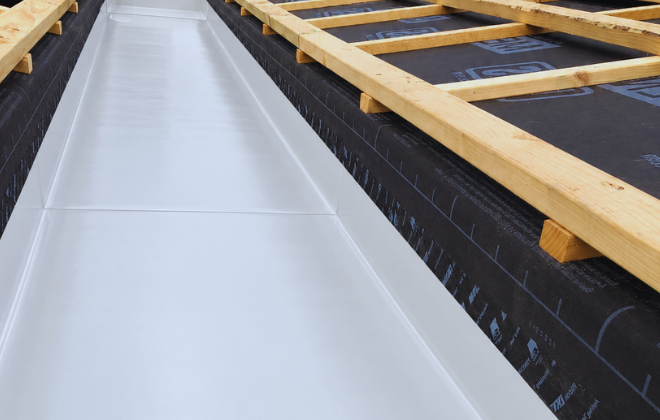
AS/NZS 3500.3 specifies box gutter falls between 1:40 and 1:200 (approximately 1.4° to 0.3°) – below the 2°/3° minimum for pliable building membranes. Instead, the rigid substrate forming the box gutter should be waterproofed in accordance with AS 4654.1 and AS 4654.2, and the roof WRB detailed to lap down onto the vertical face of the waterproofed substrate. Continuous rigid substrates and waterproofing membranes add vapour resistance, so a WUFI hygrothermal simulation in accordance with AIRAH DA07 should be carried out to assess moisture-related risks.
wufi.com.au/wufi-professionals/
wufi.co.nz/wufi-professionals/
What should I do?
Where practicable, redesign the roof to achieve a minimum pitch of 2° (Australia) or 3° (New Zealand) and adopt the Pro Clima FlatHERO® system which combines a rigid board substrate with a vapour-permeable, self-adhesive WRB. The rigid substrate minimises membrane sagging, maintains condensate drainage and reduces the water ponding that can occur with flexible WRBs.
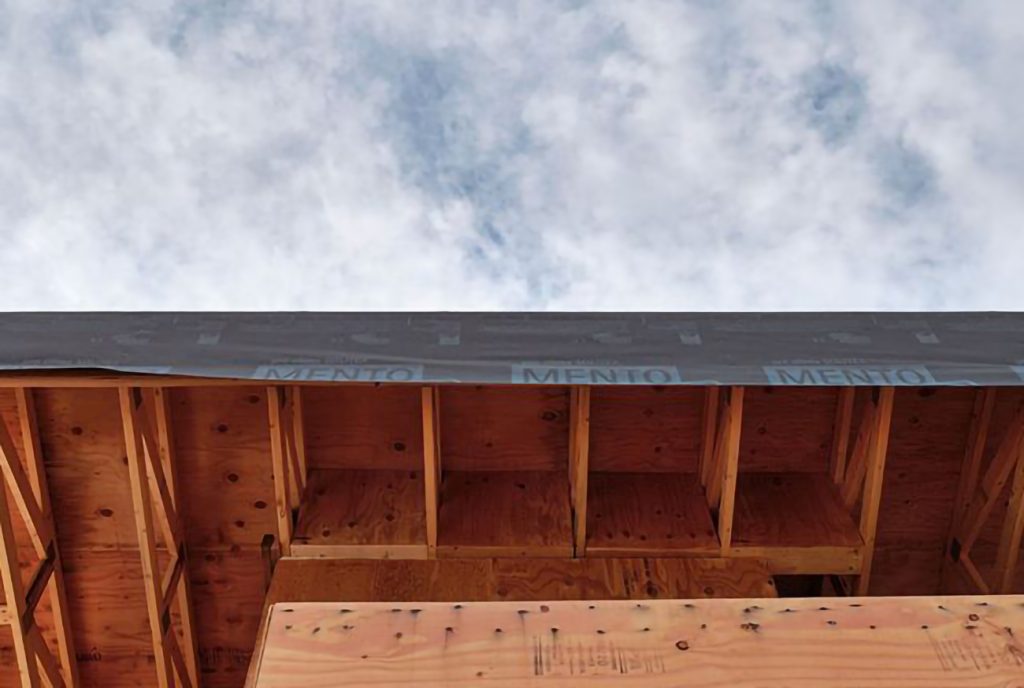
Image credit:
BTH Performance Pty Ltd, Central Coast – NSW
T White Building & Construction, Central Coast – NSW

Authors