
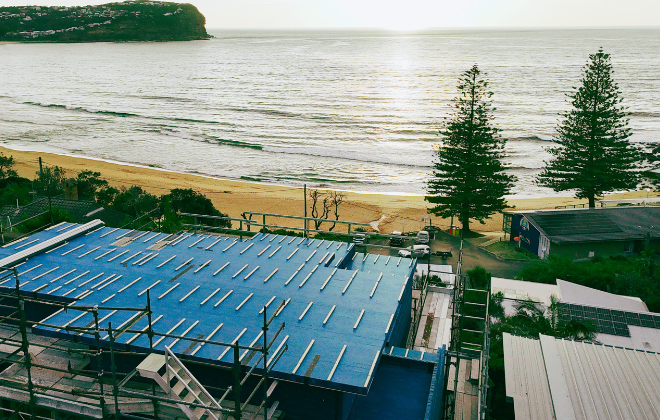
Technical Note – Salt Air, Surf Mist and Weathertightness
Why TEEE membranes hold up in coastal environments
We often get questions about the use of our weather resistive barriers in coastal environments — does proximity to the sea affect the products, whether salt passes through the membrane and poses a corrosion risk to fixings and metal components, and what happens when salt settles on the protective fleece.
pro clima’s TEEE-based weather resistive barriers use a Thermoplastic Elastomer Ether Ester (TEEE) functional film – a non-porous, monolithic layer with high resistance to water penetration, achieving vapour permeability through active molecular diffusion rather than perforation or micro-porosity. Because there is no pore structure, there is no pathway for liquid water, airborne contaminants, or dissolved salts to travel through.
In a coastal setting, salt can reach the membrane in two ways:
- bulk liquid water – wind-driven rain, splashback, or moisture finding its way in through a poorly sealed detail; and
- air movement within the cavity itself. Drained and ventilated cavities are designed to move air so that any moisture reaching the cavity can dry out. With proximity to the sea, that same airflow draws in salt-laden air from outside.
As a result, the membrane’s surface is routinely exposed to salt, whether carried in liquid water or suspended in moving air.
Does proximity to the sea degrade the membrane over time?
No. Salty sea air has no known influence on the water barrier and vapour permeance properties of the membrane. Marine aerosols are also typically mildly alkaline, and the TEEE film’s chemical stability under alkaline conditions carries over to this kind of exposure as well.
Does salt pass through the membrane to reach fasteners or framing?
No. The film’s non-porous structure means there’s no pathway for salt to travel through it, and because it functions as both an air barrier and water barrier, it stops salt-laden air and moisture from reaching the framing and insulation zone behind it.
TEEE membranes remain stable and reliable in coastal, salt-exposed environments — performing the same on day one as they do years into the building’s life.
Image credit:
BTH Performance Pty Ltd, Central Coast – NSW
T White Building & Construction, Central Coast – NSW


Authors